
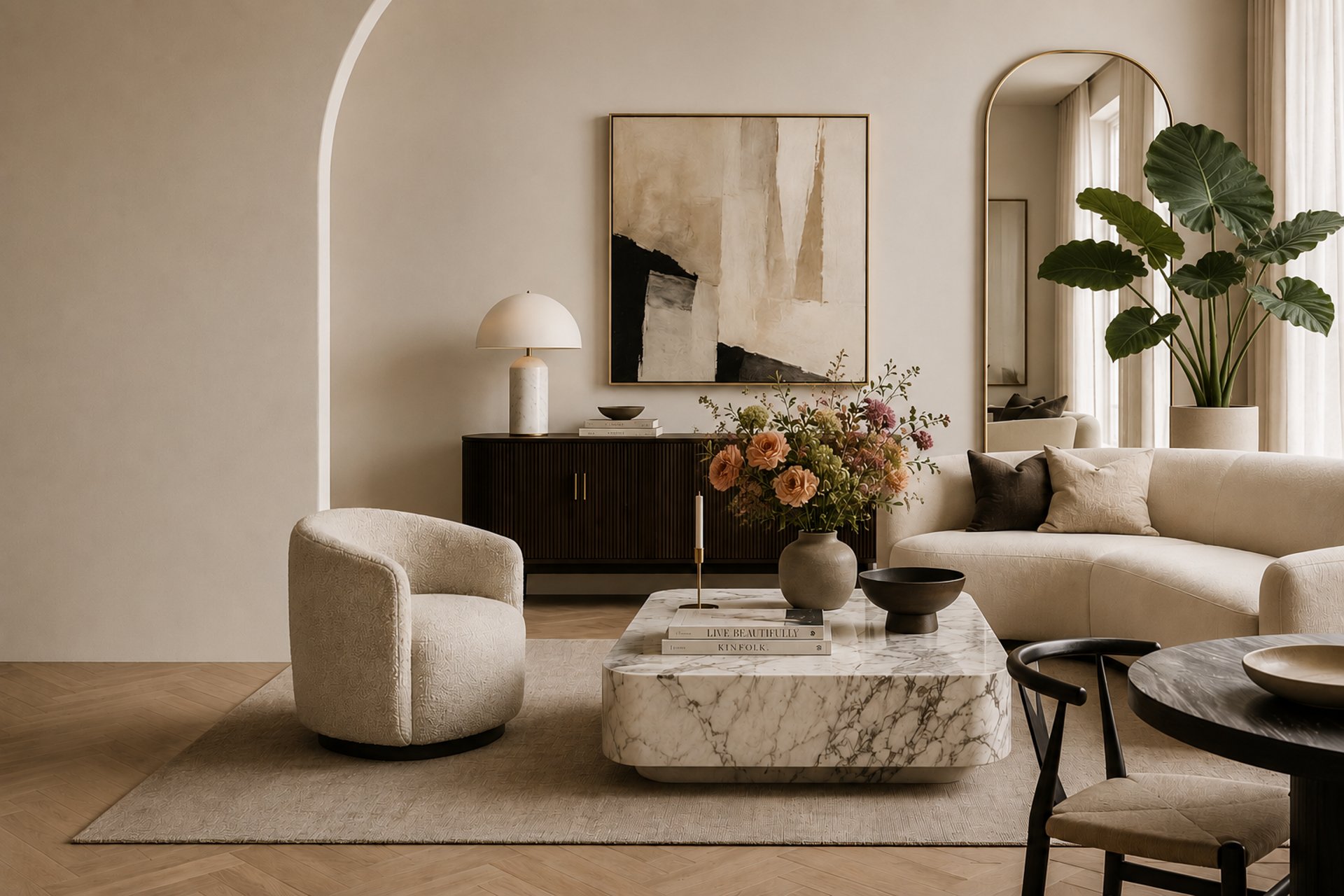
9 Furniture Pieces That Make Any Home Look High-End
Discover nine furniture pieces that instantly elevate any room. Learn which anchors, materials, and proportions designers use to make spaces look high-end.
NATURAL HOME DECOR
7/20/20269 min read
If you've ever wondered what furniture makes a home look high-end, the answer is almost always fewer pieces, chosen with precision. Most people try to make a home feel expensive by buying more: more throw pillows, more decorative objects, more accent pieces from the sale section. The result is a room that feels busy but not beautiful, layered but not luxurious. The real answer runs in the opposite direction.
After years of curating organic luxury interiors at Habiture Interior Design, I've identified a clear pattern. The rooms that stop people mid-scroll, the ones that feel effortlessly elevated regardless of total budget, are built around nine specific furniture pieces. Add the right materials and a working knowledge of proportion, and the entire room shifts. Skip any one of these elements and something always feels slightly off, even if you can't name why.
By the end of this guide, you'll know exactly which pieces to prioritize, what materials actually communicate quality when someone walks through the door, and where to source each piece without spending hours filtering through hundreds of options.
Why One Great Piece Outperforms a Room Full of Average Ones
Designers work from a principle called the anchor piece approach. Each room gets one hero, a statement piece that carries the visual weight of the entire space, and everything else layers around it. In a living room, that hero is the sofa. In a bedroom, it's the bed. At the dining end of an open-plan home, it's the table. Get the hero right, and the room coheres. Get it wrong, and no amount of styling will fully fix it.
The most common furniture shopping mistake is doing things in reverse. Homeowners buy the accent chair, the throw blanket, the decorative tray, and the framed art first, then delay the investment in structural furniture because it feels like a larger commitment. The result is a room that looks "assembled" rather than designed. Investing in one quality statement sofa will do more for your living room's perceived luxury than spreading the same budget across ten smaller accessories. This is not a budget argument. It's a sequence argument. Start with the anchors.
What Furniture Makes a Home Look High-End: 9 Pieces Designers Rely On
1. Statement Sofa
The sofa is the single most impactful furniture purchase in any living space. A low-profile silhouette with a deep seat (20 to 24 inches / 50 - 60 cm) signals a lounge-quality piece the moment someone sits down. Velvet, bouclé, and genuine leather are the three upholstery materials that read as expensive from across the room. Choose a sofa where the frame and cushion construction justify the price point. Many well-built sofas last 10 or more years with proper care, which makes the investment far more defensible than it first appears.
2. Oversized Area Rug
A rug that is too small is one of the fastest ways to make expensive furniture read as cheap. For a standard living room, start at 8x10 feet (2.4 - 3 meters), with 9x12 (2,7 - 3,6 meters) being the preferred scale for most open-plan spaces. The front legs of every major seating piece should rest on the rug, and the rug itself should extend 6 to 8 inches beyond the furniture arrangement on all sides. This anchors the entire seating zone and prevents furniture from looking marooned in the middle of the room.
3. Sculptural Coffee Table
The coffee table completes the living room trio and gives the eye somewhere intentional to land. A marble-topped or organically formed table in travertine, stone, or rattan pulls the arrangement together and communicates a curatorial sensibility. Proportion matters here too. Size it to two-thirds the length of your sofa and position it within 14 to 18 inches / 35 to 45 cm of the seat edge for a proportion that reads as considered rather than accidental.
4. Bouclé or Velvet Accent Chair
The accent chair is the most-copied luxury piece in interior design, and for good reason. Its texture reads as expensive from across the room. A curved bouclé chair or a deep velvet armchair introduces material depth and a secondary seating moment that signals the room was designed rather than furnished. Silhouette matters as much as fabric here: look for a sculptural form rather than a generic club chair.
5. Credenza or Sideboard
An elegant credenza in solid wood adds architectural weight to empty wall space and creates practical storage that never compromises aesthetics. It fills the vertical void that leaves a room feeling unresolved, and it gives you a surface to style intentionally. Choose solid wood or real wood veneer over printed laminate finishes; the material depth reads at a glance.
6. Oversized Mirror
While most people file a mirror under decor, designers treat an oversized mirror as a furniture-scale anchor. It doubles the apparent size of a room, amplifies natural light, and brings architectural significance to whatever wall it occupies. Lean a large mirror against a wall rather than hanging it at eye level for a more relaxed, editorial effect.
7. Sculptural Dining Table
A well-chosen dining table elevates the eating zone from a functional afterthought to a genuine focal point. Pair a solid wood or stone-topped table with well-crafted chairs in a complementary material and the dining space holds its own as a designed room rather than an incidental corner. Scale the table to fit the room without crowding: allow at least 36 inches between the table edge and the nearest wall for comfortable chair movement.
8. Statement Bed
In the bedroom, the bed is the hero piece, and designers recommend starting there before any other purchase. A tufted headboard in linen or velvet, a solid oak or walnut frame with clean proportions, or a low-profile platform bed in warm wood creates the boutique-hotel-at-home feeling that no amount of throw pillows can manufacture. Make sure the bed is proportionate to the wall behind it, the headboard should anchor the wall rather than float in the center of it, and that the overall scale feels grounded rather than lost.
9. Bedroom Credenza or Dresser
A bedroom credenza or dresser in real wood veneer or solid construction completes the space with material authenticity and visual cohesion. It gives the eye a place to rest beyond the bed and introduces a second horizontal plane for layered styling. A quality dresser in warm walnut or oak reads as an investment piece and ages in a way that printed laminate alternatives simply do not.
What Materials Actually Communicate Quality the Moment You Walk In
Authenticity is the single most critical factor in a high-end finish. Natural materials carry visual depth that manufactured alternatives cannot replicate, and that depth registers almost immediately when someone enters a room. Velvet absorbs light and creates tactile richness that reads as regal. Genuine leather develops a patina over time, itself a luxury signal, because it proves the material is real. Solid wood in walnut, oak, or teak brings warmth and organic variation that printed laminates flatly lack.
Brushed brass is the warm metal finish that consistently suggests luxury without feeling overdone. Unlike shiny gold, a brushed or antioxidized brass finish interacts with light softly, creating a sense of considered elegance rather than flash. The detail that separates a designed room from a decorated one is deceptively simple: coordinating all metallic finishes in a room into a single family. Curtain rods, lamp bases, drawer pulls, and picture frames should all speak the same metallic language. When they do, the room feels intentional. When they don't, it reads as assembled.
The Sizing and Proportion Rules That Make Furniture Read as Custom
Proportion is where most well-intentioned rooms quietly fail. The sofa's seat depth should fall between 20 and 24 inches (50 to 60 cm) for a lounge-quality feel. The coffee table should be two-thirds the sofa's length and sit within 1 to 2 inches (2,5 to 5 cm) of the sofa cushion height. The rug should extend 6 to 8 inches (15 to 20 cm) beyond the furniture arrangement on all sides, with the front legs of every major seating piece resting on it. Violating these ratios makes even expensive furniture look wrong.
Window treatments follow an equally important logic. Curtains hung at ceiling height rather than window height elongate a room dramatically. Mount the rod 4 to 6 inches (10 to 15 cm) above the window frame, or flush with the ceiling for maximum effect. The difference is significant. Make sure the total curtain width is 2 to 2.5 times the window width for full, luxurious folds. Beyond windows, maintain what designers call the 60/40 floor space rule: furniture occupies roughly 60% of the floor, leaving 40% as visual breathing room. This is what keeps a thoughtfully furnished room from reading as cluttered.
The Styling Layer Most People Skip
One of the clearest signals of a high-end room is furniture that floats rather than hugs walls. Pull the sofa at least 6 to 12 inches (15 to 30 cm) away from the wall, or more if the room allows, and arrange seating around the coffee table as a central anchor. Main walkways should maintain 30 to 36 inches (76 to 91 cm) of clearance. Cramped or wall-hugging furniture makes even well-made pieces look incidental, as if they were placed rather than positioned.
Style surfaces using odd-number groupings of three or five objects, varying heights between low, mid, and tall elements within each vignette. Layer lighting with intention: ambient overhead light sets the base, task lighting serves function, and accent lighting is where luxury actually lives. A floor lamp placed beside a statement chair, or a sconce washing light down a credenza, elevates a piece of furniture the same way gallery lighting elevates art. Install dimmers wherever possible. The ability to shift a room's mood from afternoon brightness to evening warmth is one of the most underrated upgrades in any home.
How to Source These Pieces Without the Overwhelm
The investment hierarchy matters. Prioritize the statement sofa, the piece that carries the room, and the area rug that anchors it. For sofas, mid-range retailers like Article, West Elm, and CB2 typically offer genuine quality in the $900 to $2,500 range without the lead time of custom upholstery. The splurge tier, Restoration Hardware and custom workrooms at $3,000 and above, makes sense when the sofa is the clear hero of the room. Budget more responsibly on accent chairs and side tables, where a well-chosen silhouette in a quality fabric from a mid-range source reads just as elevated as a designer option.
That is where Habiture's curated Favorites section comes in. Instead of filtering through hundreds of options across mass-market retail sites, Habiture's handpicked furniture edit is organized by category, sofas, accent chairs, rugs, tables, and lighting, and selected through the same organic luxury lens that runs through this entire guide. Every piece is evaluated for material quality, silhouette integrity, and long-term aesthetic fit. For anyone who now knows exactly what furniture makes a home look high-end but doesn't want to spend hours sourcing it, the Favorites section is the shortcut a well-connected designer friend would offer.
The Framework That Changes How You Shop Forever
A high-end home is not the product of a large budget. It is the product of disciplined choices. The nine pieces covered here, chosen in the right materials, sized to the right proportions, and styled with intention, do more for any room than any amount of layered accessories placed over a weak foundation. It's also worth noting that lighting fixtures and original art frequently rank alongside furniture as the highest-impact elements in a designed room; the pieces in this guide form the structural backbone, but those additions are what complete the picture.
Knowing what to prioritize, and why, is the first step. Acting on it with a curated, considered edit is the second. Start with one anchor piece in the right material at the right scale, build from there, and let each decision serve the whole. Head over to Habiture's Favorites section to begin sourcing with confidence, and without the overwhelm of starting from scratch.
Frequently asked questions
What furniture makes a home look high-end according to designers?
Designers use an anchor piece approach: each room needs one hero item (a statement sofa in living rooms, a bed in bedrooms, a dining table in dining zones) and a few complementary pieces. Habiture Interior Design identifies nine specific furniture pieces that, when chosen with the right materials and proportion, make a room read as effortlessly elevated rather than busy.
Why is the sofa the most impactful furniture purchase for a living room?
The sofa is the visual and functional anchor of the seating area; a well-proportioned, low-profile sofa with a deep seat (20 to 24 inches / 50 - 60 cm) immediately signals lounge-quality. Upholstery like velvet, bouclé, or genuine leather and solid frame and cushion construction justify the investment because many well-built sofas can last 10 or more years with proper care.
How should I size an area rug so my room looks expensive?
Start with at least an 8x10 rug (2.4 - 3 meters), with 9x12 for a standard living room, with 9x12 (2,7 - 3,6 meters) preferred for most open-plan spaces. Make sure the front legs of every major seating piece rest on the rug and that the rug extends about 6 to 8 inches beyond the furniture arrangement to anchor the seating zone.
What kind of coffee table and accent chair make a space look curated?
Choose a sculptural coffee table in marble, travertine, stone, or rattan and size it to roughly two-thirds the length of your sofa, positioned 14 to 18 inches / 35 to 45 cm from the seat edge. For an accent chair, opt for a curved bouclé chair or a deep velvet armchair: the texture reads as expensive from across the room and introduces a luxe material depth.
Is it worth investing in higher-quality furniture for longevity?
Yes, investing in well-built structural pieces like a quality sofa often pays off because many last a decade or more with proper care, making the upfront cost more defensible. The emphasis in the article is on prioritizing durable frames, cushion construction, and luxe materials that read expensive from across the room.
How does using fewer pieces create a high-end look?
Fewer, precisely chosen pieces allow each item to carry more visual weight and create a coherent composition; too many objects make a room feel busy rather than luxurious. A single great anchor piece paired with the right materials and proportion shifts the entire room more effectively than spreading the same budget across many average items.
What's the biggest mistake people make when furnishing a room to look high-end?
The most common mistake is buying accent pieces first—chairs, throws, trays—and delaying the investment in structural furniture, which leads to a room that looks assembled rather than designed. The article argues this is a sequence issue: start with the anchor or hero piece, then layer accessories around it.
Habiture Interior Design
Habiture is an interior inspiration platform helping you create a warm, soulful home through natural materials, timeless interiors and carefully selected home decor products and pieces. Discover mood boards, interior products and our favorite finds.
Contact
Sign-up for our newsletter
© 2026. Habiture Interior Design. All rights reserved.
Some links on this website are affiliate links, which means we may earn a small commission at no extra cost to you.